|
 News
News
|
Costa Rica | Varieties
Costa Rica promotes the production of a tomato hybrid developed by the UCR This new production alternative stands out for its tolerance to diseases such as bacterial wilt and tomato leaf curl virus (TYLCV), as well as for its excellent post-harvest quality, which prolongs its shelf life. 1/21/2026
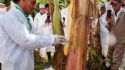
 Farmers participating in the project. Farmers participating in the project.
The Ministry of Agriculture and Livestock (MAG) of Costa Rica delivered fertilizers to five selected producers as part of a pilot project for the implementation of the "armored tomato" variety developed by the University of Costa Rica (UCR). This hybrid is the result of more than five years of scientific research conducted at the Fabio Baudrit Moreno Experimental Station (EEAFBM). This new production alternative stands out for its tolerance to diseases such as bacterial wilt and tomato leaf curl virus (TYLCV), as well as for its excellent post-harvest quality, which extends its shelf life and reduces losses during transport and storage. The "armored tomato" has high Brix levels, high nutritional value, and remarkable organoleptic characteristics, attributes that position it as a differentiated product for markets that prioritize quality and responsible production. Additionally, it requires reduced use of agrochemicals, making it an ideal option for institutional food security programs. Regarding this initiative, the National Director of Agricultural Extension, Karla Mena Soto, highlighted: “This crop represents a real opportunity to strengthen the country's food security through scientifically validated agricultural alternatives with less environmental impact and high nutritional value. For the productive sector, it means access to innovation, competitiveness, and new market opportunities.” In line with this approach, the Ministry of Agriculture and Livestock (MAG), through the National Production Council (CNP), is promoting the incorporation of this hybrid into the Institutional Supply Program (PAI) by linking five producers as suppliers. This strategy is being developed in coordination with the Ministry of Public Education (MEP) and aims to supply 34 educational centers in the province of Alajuela with a crop of high nutritional value. This inter-institutional work contributes to strengthening national agricultural production, promoting more sustainable systems, and providing access to fresh and healthy food for the student population.
Sign up to our newsletter
|
|||||||||
© Copyright Infoagro Systems, S.L.